Monday, February 25, 2013

You Are a Writer

By Dan Haring

Raise your hand if you're an aspiring writer.


I'm sorry, but you're wrong. You're not an aspiring writer. You are a writer.

What does aspire mean? "To seek to attain or accomplish a particular goal. From Latin aspirare, literally, to breathe upon."

I see you over there, in the corner, breathing onto your laptop.

"Shhh...I'm aspiring over here."

No you're not. You're writing. 

If you have, at one point, put pen to paper or fingers to keyboard and written something - a poem, a short story, a screenplay, the first chapter to the next great American novel, you are, in fact, a writer.


Now, if you haven't, if you're still just breathing on the paper, but not putting anything on it, then, I guess, technically you're an aspiring writer. But that's okay. The great thing about writing is all you need is that pen and paper or that keyboard. There should be very little, if anything, physically holding you back.

Now, you might say that I'm stupid for that whole breathing thing. You might be thinking "I really AM an aspiring writer. I want to write the next Harry Potter or Twilight or On the Road or Catcher in the Rye."

And that's great. It's great to have those goals. But let's go back to the definition of aspire. To seek to accomplish a particular goal. You are an aspiring best-selling author, which is something altogether different.

It means you're serious about this whole writing thing. It means that you're not just going to mess around, but that you're going to take your craft and make it into something people will pay you money to read.

And that's awesome. You need to have goals, whatever they may be. But that's just it, The goals are the finish line, and you're never going to reach them if you don't pick up that pen.

So just write.

Some of you might be rolling your eyes and saying "Ok, we get it, can you move on to the next visual?"

The answer is yes.


This is me and my two sons at the 2010 San Diego Comic Con. The lady we're with is comic book writer Gail Simone, who has written tons of comics, including characters such as Batman, Wonder Woman, Superman, Deadpool, etc. (My kids are obviously impressed) And this is right before I turned to her and asked if she had any advice for an aspiring comic book writer.

I'm pretty sure I even used those exact words.

I'm not even going to make an excuse for myself. The point is, the second you make that effort and start writing, You've changed into a writer, so don't sell yourself short.

The reason I'm spending so much time on this is I've heard so many times from friends. "Oh, that's cool you wrote a book. I wish I could." Like it's some magical fairytale thing that I somehow managed to do and that they'd never be able to.

But it's not magic, it's just a matter of working hard.

So stop aspiring. Start writing. And if you've already started, keep writing.
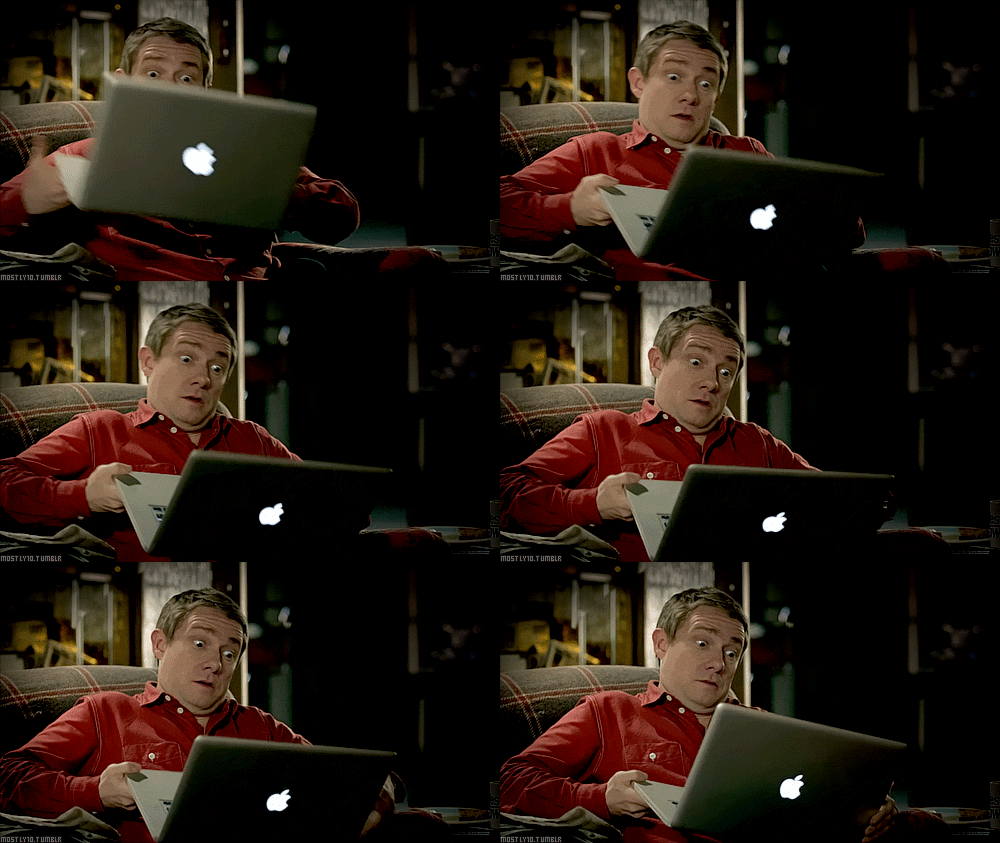


I promise it's not as scary as it sounds. 


Friday, February 22, 2013

5 Keys Ways to Add Depth to Your Fictional Relationships

Jordan Dane
@JordanDane


In Indigo Awakening (Book #1 in my “The Hunted” series for Harlequin Teen)—there is a love triangle that is layers deep. I’m a sucker for love triangles, but I wanted the one in Indigo Awakening to be a little more than a girl’s attraction to two very different boys. At the apex of this triangle is a very strong girl, Kendra Walker, the leader of an underground movement of Indigo children and feelings run high when beliefs and ideologies are tested.
 
Lucas Darby is psychic and becomes mentally linked to a girl he hears in his head after he escapes from a mental hospital. Kendra thinks she has made contact with another lost Indigo, but after she realizes that Lucas is a powerful Crystal child, she sees the future she always dreamed would be possible. And for Lucas to connect with the “hive mind” for the first time, the link is intoxicating and seductive. Kendra is older than Lucas, but for him their connection is as intimate as making love for the first time. It changes everything for both of them. Since Lucas is evolving into a Crystal child, the next evolution of mankind, Kendra is motivated to be with him so she can be a part of a new, more powerful movement. She is a modern day Joan of Arc on a mission to save the Indigos, but someone else is her rock when it comes to protecting her Indigo children.
 
Another boy, Rafael Santana, has helped Kendra build a safe underground oasis for the homeless Indigos. Rafe has feelings for Kendra that he’s never shared with her, but he’s also driven to protect Benny, a 10-year old boy he loves like a little brother. This conflict will drive how he reacts when Kendra’s Indigo revolution threatens the home he wants for Benny. After she focuses her attention on Lucas, Rafe becomes jealous, but in his quiet way he deals with it until the conflict between the Indigos and the Believers blows up, the fanatical church zealots who hunt Indigo kids to stop the next evolution of man. Rafael’s love for Benny collides with his loyalty for Kendra and changes everything.
 
Kendra must choose how far she is willing to go to save her Indigo family—the one she has and the one she’s dreamed about. Lucas, the powerful Crystal child, represents the future she had always hoped for, but Rafael is the heart and soul of the past she started with him—the boy who made her dream possible.
 
Key steps to adding depth to your fictional relationships:
 
1.) Give a strong character vulnerabilities that conflict with what they might want and force them to choose. There are consequences to actions. Someone’s gotta lose, even in love.

2.) Give them choices that test their emotions. Their choices shouldn’t be easy. For example, make them choose between their personal happiness or the greater good. This is classic and always relatable.

3.) Pair them with opposite types of characters to enhance the conflict potential. Opposites attract for a reason. Fireworks, baby.

4.) Create internal conflicts or flaws that make them struggle with their external goals and the goals of the character(s) you’ve paired them with. Conflict is key to any great story. But add depth to your character by layering the conflict inside them first.

5.) Give them a noble cause that is a roadblock to their personal happiness. What would they do? Not every character would make the same decision.

 
Discussion Questions:

1.) What would you add to this list?

2.) What are some of your favorite literary or film love triangles? Please share your thoughts on why they resonated with you.

 
"Dane's first offering in her new series, The Hunted, is sensational. Indigo Awakening has strong characters and a wild and intense story, matched only by the emotions it will generate within you. Readers will love this book and eagerly await the next adventure. Fantastic! A keeper."
4.5 Stars (out of 5)
—Romantic Times Book Review Magazine

Thursday, February 21, 2013

Armchair Audie Nomination

by Amanda Stevens

I have to confess, I was unaware of the Armchair Audies until Khristine Hvam Kies, the narrator for The Graveyard Queen series, posted on my Faceback wall that we had been nominated.  Now that I've done a little research, I realize what a very cool thing this is!  And I also recognize that much of the credit belongs to Khristine for her amazing interpretation of my story. Yay, us!

You can see a complete list of the nominations at AudioFile Magazine.

Another confession, the first time I listened to one of my books on audio--hearing my words spoken by someone besides the voices in my head--kind of freaked me out and made me super critical of what I'd written.  It was also strange to hear the differences in cadence, pauses, emphasis and so forth from what I had originally intended.  Not better or worse, just different. 

Anyone else listen to their own audiobooks?  I can't do it.  Like reviews and mirrors, I tend to shy away from them.

Monday, February 18, 2013

Permission to Play

So I got the sweetest emails this past week from a couple kids.  These were a little different from the very nice letters I normally get because the kids asked more or less the same question, and one I'd never have expected: was it okay if they wrote stories set in the ASHES universe?  More to the point, could they write about a particular character they really liked?  Could they make up new characters and run with them?  (One kid even said she'd modeled her Minecraft world on ASHES.)

In other words . . . these guys wanted permission to write fan fic. 

Well, knock me over with a feather.

As an unabashed but recovering Trekker, I'm no stranger to fan fic.  Heck, "A Ribbon for Rosie," my first published story--and a prize-winner, to boot--was fan fiction set in the Voyager universe.  I've done a ton of work for hire, and I count many tie-in writers as friends and colleagues.  A couple, I recently tagged for the Next Big Thing Blog Hop because, in my experience, tie-in and wfh writers get too little respect and recognition for a lot of very hard work.  (And I know the work's hard because I've been there, done that--and anyone who thinks it's easy doesn't know apples from their . . . well, use your imagination.)  What people forget: sure, the universe may already exist, but for a wfh-writer, every word is original.  Every plot is theirs, even if they must get a certain character from A to B by the end of the book.  They just don't own the copyright.

No, this isn't going to be a diatribe on a variant of wfh writers don't get no (or enough) respect, even though they don't and most especially not from big-name publishers.  All of us who've done wfh and tie-ins know that.  <shrug>  You learn to live with and come to a state of grace about that, while at the same time realizing that, to the fans of those universes, your books are a big deal.  Having gone to GenCon and a bunch of ST conventions, let me tell you: these fans are loyal; they'll stand in line for hours; they're dying for you to write that next book.

But I digress.  What I thought about when these kids popped into my inbox was the fun I had, as a kid myself, making up my own stories about, oh, Batman, Star Trek, Lost in Space . . . even My Favorite Martian.  At a certain level, every child who's ever opened a book or become a fan of a show or movie inserts herself into the narrative.  It's inevitable; this is what it's like to be lost in a book.  There's a fancy name for it in media studies: textual poaching.  While the French critic, de Certeau, wrote about this first, I'm a bit more familiar with Henry Jenkins's work that focused on the Trek universe (and, at the time, while I didn't find all his points that convincing, the theory's right on--and, oh, I do love that cover).


  While I agree that this kind of appropriation is all about power and resistance--think, for example, of all that good, homoerotic Trek slash fiction out there--the reality is this: when people find a world compelling, they want to be a part of it any way they can.  The psychology that drives this is no more mysterious or different than the desire to dress up on Halloween or cut loose at Mardi Gras, both socially sanctioned opportunities to act out fantasies.  That this acting-out is limited; that there are boundaries you can't cross . . . this is where the power inequities come in that Certeau and Jenkins are talking about.  You can create on paper what you can't do for real.  You can enter a universe you desperately want to be a part of on your own terms.  It's what drives the desire to write and the fun of reading fan fiction.  

So, is fan fiction wrong or bad?  Well, it depends, doesn't it?  Copyright protections exist for a reason.  Can you write fan fiction?  Sure, without question.  What you can't do is write and then show what you've written to your friends, or post it on the web, etc., for money.  But what if you share your story with only one friend?  Or two?  Or ten?  When does this sharing, this more-than-one-person experience, become a violation?  Is it a violation only when you do it for money? 

As you might expect, there are authors who fall on both sides of the fence about this.  I'll tell you what I told those kids: I used to do the same thing when I was your age; I'm thrilled you love my stories; I'm tickled my work inspires you to try your hand.  

Now, did I encourage them to write their own original stuff instead?  Of course.  But do I understand the impulse?  Sure.  Can they sell what they write?  No.  Can they show it around?

Gosh . . . I'm divided about that because then you're getting into the tricky slippery slope part.  On the one hand, all they're doing is spreading the love, and that makes me feel good.  Honestly, if there's enough love and drive out there, this kind of thing becomes unstoppable.  I know; I'm a Trekker; grabbing that narrative and continuing those stories was half the fun, and what eventually got me writing.  If fan fiction encourages kids to read and write, I'm all for that, too.  You can argue that fan fiction has a lot going for it and benefits you might not have imagined.

But . . . here's the bugaboo: what about the people who may, eventually, charge a couple nickels for a story?  Who give folks a taste, and then tell them that if they want more, they have to pay?  See what I'm saying?  Now they're making money off something that I-- some other writer/actor/painter--own.  

So, yeah, the potential for abuse is there.  My gut is that most fans are polite; they're enthusiastic; they understand that the sand has to remain in the box.  To be honest, I see more good coming of this than bad. 

Granted, I really don't have to worry about this.  Stephen King has these problems, not me.  For the moment, I'm just tickled a couple kids out there like the series and want to play in that sandbox.  So long as they behave--now, Joey . . . no, honey, you really can't throw sand in Jessie's eyes--it's all good, and maybe a lot more because what they build, they build from the ground up with passion and love for what I've given them.

Go for it, kids.