Last week, I took my cue from Kris Rusch’s business blog on discoverability to talk about the task of getting the word out about your book, especially in an era when traditional publishers may be doing less and relying much more on you, the writer, to market yourself. (That imperative is, by the way, why most of us writers have blogs and do social media.) Certainly, marketing yourself is nothing new. Talk to any writer who’s been around a while or her agent, and one of the things publishing houses used to want to know was whether you’d go on tour—and, by extension, if you were the kind of writer a publisher could send out there. Not all writers could/can. Some folks are excruciatingly shy; others are boors; some pick the worst times to get drunk; a couple may be hygienically challenged . . . you get the picture. But the idea was that giving folks a chance to connect with a writer—especially those all-important booksellers—would really help readers discover a book.
That personal connection was important, and still is because what we’re really talking about is word of mouth. In the olden days—like a couple years ago when Borders and Waldens and indies were going strong—that word of mouth was frequently a real live person at a real live story pressing a real book into a customer’s hands. Booksellers got to know their clientele. Conversely, writers formed relationships with booksellers and, if they were very savvy, with their readers that they then maintained. Nowadays, people have blogs, right? Well, way back then, many writers sent out newsletters. Some still do in lieu of or addition to blogs; I know of at least a few because I’ve received them. (Why? Simple: I wrote these writers fan letters a while back, and they responded with newsletters. I’ve been on their mailing lists ever since. Now…have I read the newsletters? No. Why? I wasn’t interested. I know: terrible but true. I didn’t care about pictures of a writer’s dogs or where an author went on vacation. In fact, I rarely pay attention to personal stuff like that, but I don’t think I’m typical that way. Many readers do care about that kind of thing, and I certainly understand it. It’s the same kind of curiosity that I might have about, oh, an actor I like.)
These days, of course, those kinds of very personal connections—where someone presses a book into your hands—are much rarer. In the case of teens, especially, I’m thinking that librarians are the folks who have always fit that job description. They’re the people who know what’s out there and they know their kids; there is, in fact, no greater gift a librarian can give than to hand a kid a book (and this is something I’ve written about, too). Having hung around a bunch of librarians, I’ve discovered that word of mouth is what it’s all about. Librarians bring in speakers; they do book talks; they point teachers to new books; they place books on display that they think are worthwhile. Come right down to it, libraries are the bookstores of tomorrow, and probably one of the few venues where kids will actually continue to be able to come into contact with physical books.
So word of mouth is key, and I was reminded of this just the other day. I was at some party, and we were talking about books we’d read recently. A couple titles came up, and more often than not, the response from folks who hadn’t read a particular work was something like, oh yeah, I’ve heard good things about that. Press just a tad more, and you come to find that, say, a friend mentioned a book, or a friend of a friend, a librarian, a work colleague. Not one person mentioned that she’d seen an ad or book trailer; that he’d read a blog or seen a post on Facebook or gotten into a Twitter conversation. One or two said they’d read a review (none of these were blog reviews). The overwhelming majority of responses revolved around word of mouth—and only rarely was this online word of mouth.
On the other hand, I wonder if this isn’t a problem with the target demographic. Remember, it was a party of adults not teens, and I know for a fact that, other than I, none of these other adults uses social media at all.
So it’s more than likely that teens, who have the fastest thumbs in the known universe, might have a different answer about how they get or transmit their information—pass on a recommendation via word of mouth—online. In fact, a very recent Harris Poll suggests that many people do use social media with the express purpose of influencing others. I know I do; I regularly put up tweets and Facebook about environmental causes because I want to bring these things to people’s attention. Hang around Facebook or Twitter long enough, and you realize that trying to get people to come around to your point of view is frequently what a lot of posters are after.
A cursory search—and I do mean, bare-bones fast and dirty reading of a couple abstracts—regarding the importance of online word of mouth gives contradictory data. One study suggests it has zilch impact (which I find very hard to believe) while another, looking specifically at sales and the impact of reviews on sites such as Amazon.com, concludes that the more reviews there are, the better and that negative reviews have a far greater impact on sales than overwhelmingly positive reviews. I had to step back from that one for a second, too, and think about it, especially that bit about the impact of negative reviews . . . and you know, I think that’s right. I know that if I see an even split in reviews, I tend to go to the three- and two-stars. Now maybe that’s because I’m a Freudian and the glass is always half-full . . . but I don’t believe that any book is flawless, mine included. So I pay attention to the less-than-rapturous reviews.
That actually reminded me of a ploy one author, who shall remain nameless, tried a couple years back. Through Goodreads, the writer offered the full text of a new ebook to anyone who wanted it prior to its date of sale with the proviso that you, the reader, would agree to leave a review (good or bad) on Amazon. I admit; I was intrigued, so I asked for a copy. Well, I hated the book. I hated the book so much I couldn’t, in all conscience, leave that kind of review because, being an author, I just couldn’t do that to another writer. So I wrote to the author, explained my reasoning, and that was that.
On the other hand, I now understand that author’s strategy. Is it a good one? Well, that writer sure thinks so, and Amazon sales of that author’s titles would certainly support that.
If the goal, then, is to generate word of mouth, how can I, Mere Mortal Writer, help that along? Sure, trade reviews can be gold (or killers, if no one likes the book). But it seems to me that, taking into account that writer’s Amazon ploy, we’re after volume here. We want to do things that will increase visibility. Now, for some writers, that may mean offering the book up for a read and review. I’ve seen writers offer the first x-number of pages or chapters for free while others might give away the first book in a series. (In 2008, Neil Gaiman tried a variation of that ploy with American Gods by getting his publisher to give away the ebook for a month—and, yeah, the book still did well once the giveaway was over and people had to pay again.)
But we still come around to the same problem: as any decent businessman will tell you, consumers rely on the opinions of people they trust. In the olden days, this meant they trusted friends . . . i.e., real live flesh-and-blood people they actually knew. But these days--with all these different platforms and social media available--what constitutes a friend? What are the parameters of trust? Think about it. The trust I have in friends--people I actually see and know--is very different than the trust I might have in people I know only through an online presence. I would, for example, never give out personal information--my birthdate or address or the names of my kids--on the Internet. So what kinds of "friends" are we talking about anyway, and how far do we let them influence us? (Do people even realize or stop to think that many, many of the tweets they see are generated by Twitter bots? That a computer program can generate the illusion of popularity?)
Conversely, how do you decide which platform(s) to use? Because, let's face it, no one platform fits all needs or hits the right audiences. Yes, I use Twitter and Facebook (and the latter more than the former), but I've yet to figure out how to best make use of Tumblr or, for that matter, Instagram.
And there is also the issue of time: every moment I'm using social media or writing this blog is time I take away from writing a book, and you have the problem of diversifying your message. For example, what you post to Twitter might not be what you post to Facebook or Tumblr; or if you do cross-post, is what you're posting of interest to the people most likely to be using that particular medium?
These are all intriguing questions, and I'll be the first to admit that I have no definitive answers. Over the next couple of weeks, though, I'd love to hear what other people think has worked for them, or influenced their decision-making, just as I'll be thinking about what direction I might want to take for upcoming releases.

Showing posts with label yalit. Show all posts
Showing posts with label yalit. Show all posts
Monday, December 2, 2013


Monday, November 18, 2013
Taking Chances, Pushing the Envelope with WHITE SPACE
Last week, I mentioned that I’d be on Goodreads answering all things Bick. I got some terrific questions, too, covering everything from MONSTERS to the things I love and hate about being a writer. In all that, there were a fair number of questions about the first book in my upcoming, two-volume Dark Passages series, WHITE SPACE. By now, word’s gotten out that the book is . . . pretty different. A couple aspects that seem to intrigue people revolve around the book’s structure, including multiple POVs. As with all questions, I give my answers a fair amount of thought, and so I figured, okay, since this is on people’s minds, why not simply share one very excellent question about the book and my answer here?
Oh, and before I forget: a heartfelt thank you to the David Estes Fan Page and YA Book Lovers Unite Discussion Group for letting me barge in for a week and speak my peace. If you want to see what follows in context (and get a gander at the entire week-long discussion), drop by here.
* * * (Jeann)I'm excited about your upcoming book White Spaces(sic). I hear there's many POVs within it, could you tell us about how this is weaved into the story? How do you think readers will find your new release?
Thanks! But I'm not sure how to answer your question. I mean, there are many POVs in the ASHES trilogy, too, if you think about it. So the challenge is in creating compelling characters, each with a distinctive voice, to help people keep things straight. For this particular book, because I'm not building on characters you've heard about in the first book (e.g., in SHADOWS, you already knew who the main players were), I help people a little bit by heading each chapter with the POV's name (Lizzie, Emma, Eric, etc.).
Are there are a lot of people to keep track of (in WHITE SPACE)? Sure, but there are tons of characters in books by Dickens and Stephen King and Dan Simmons and . . .
I trust that a) my readers have brains and b) they come to my books--and this one, in particular--understanding that it's not the same-o, same-o. To be honest, I think that part of the predictability problem with a lot of YA is that writers limit their POVs because they think it'll be "easier" on their readers. In a sense, they're right; it's not like I've NEVER written a book from first-person POV. I write whatever POV the story demands. That means I won't shy away from bigger, broader novels with multiple POVs because that limits your options as a writer and may act to the detriment of your story. (I can think of MANY very popular trilogies that falter because of this problem. MANY. OTOH, they're ridiculously popular . . . so don't pay any attention to me.) And, frankly, every time you write, you ought to try something you've never done before. Otherwise, you get stale, and so does your writing.
 WHITE SPACE really hinges on readers "getting" the conceit: what the different POVs are about; why they're playing out the way they are. That means I do weird things in the narrative, but because it's also partially horror, weird fits in naturally in terms of genre.
And I honestly think about things like that with every book. One of the lovely things about YA is you can get away with genre mash-ups. YA readers are, in some ways, much more flexible that way. So, you can stretch genre limits and expectations--but you must also really understand the conceits and structures of (and to) the genres you're playing with.
So, in WHITE SPACE, I do things you wouldn't expect, like end chapters in mid-sentence or with ellipses or dashes. I'm not trying to be cute, although--yeah--I'm shaking up expectations. (If you think about it, I did that at the end of the first ASHES book. Boy, were people mad and my editor was nervous because of it. But you weren't indifferent. I also ended it that way for a very specific, fairly artsy-fartsy reason: at the end of that book, Alex has discovered that all the niceties, everything she's ever taken for granted, are gone, stripped away. Civilization as she's known it has collapsed. So I wanted to give my readers that same kind of gut-punch shock. Nothing is nice and predictable for her anymore . . . so why should they be for you?)
In WHITE SPACE, I play with form to cue your mind about what's going on in the only ways available to me as a writer without sitting you down for a very boring, fairly condescending "you-know-Bob" moment. I know you guys are smarter than that. (But if you want a hint--or a movie that I mention in the book and which I think plays with the same concepts I do--then check out IDENTITY. Really interesting flick, and in some ways, much more inventive than INCEPTION, though that was also a great film.) As for how they'll find it . . . I'm going to presume you mean . . . "like" it? Or do you mean, figure out I've written it? The latter's easy ;-) As for the former, I don't know if people will like it; I hope they do. I think it's a book and concept that has the virtue of never having been tried in quite this way. (I'd like to think I'm a bit like Kirk this way.)
But . . . WHITE SPACE is a very different read. I know that going into this. It's not your standard kind of book, and I also understand that not everyone will "get" it. But you take that risk with every book. (I was going to go all artsy-fartsy and say something about how boring any art would be if all we did was churn out identical narratives or paintings or songs . . . but that's way too serious for me. Is writing an art? Sure . . . but above all else, I'm an entertainer. That's my job. You pick up a book to be entertained, not because you need your daily dose of art.)
So, changing things up, taking chances, trying something new . . . all that keeps things fresh. It's part of the terror of writing, and--for me--most of the fun.
Oh, and before I forget: a heartfelt thank you to the David Estes Fan Page and YA Book Lovers Unite Discussion Group for letting me barge in for a week and speak my peace. If you want to see what follows in context (and get a gander at the entire week-long discussion), drop by here.
* * * (Jeann)I'm excited about your upcoming book White Spaces(sic). I hear there's many POVs within it, could you tell us about how this is weaved into the story? How do you think readers will find your new release?
Thanks! But I'm not sure how to answer your question. I mean, there are many POVs in the ASHES trilogy, too, if you think about it. So the challenge is in creating compelling characters, each with a distinctive voice, to help people keep things straight. For this particular book, because I'm not building on characters you've heard about in the first book (e.g., in SHADOWS, you already knew who the main players were), I help people a little bit by heading each chapter with the POV's name (Lizzie, Emma, Eric, etc.).
Are there are a lot of people to keep track of (in WHITE SPACE)? Sure, but there are tons of characters in books by Dickens and Stephen King and Dan Simmons and . . .
I trust that a) my readers have brains and b) they come to my books--and this one, in particular--understanding that it's not the same-o, same-o. To be honest, I think that part of the predictability problem with a lot of YA is that writers limit their POVs because they think it'll be "easier" on their readers. In a sense, they're right; it's not like I've NEVER written a book from first-person POV. I write whatever POV the story demands. That means I won't shy away from bigger, broader novels with multiple POVs because that limits your options as a writer and may act to the detriment of your story. (I can think of MANY very popular trilogies that falter because of this problem. MANY. OTOH, they're ridiculously popular . . . so don't pay any attention to me.) And, frankly, every time you write, you ought to try something you've never done before. Otherwise, you get stale, and so does your writing.
And I honestly think about things like that with every book. One of the lovely things about YA is you can get away with genre mash-ups. YA readers are, in some ways, much more flexible that way. So, you can stretch genre limits and expectations--but you must also really understand the conceits and structures of (and to) the genres you're playing with.
So, in WHITE SPACE, I do things you wouldn't expect, like end chapters in mid-sentence or with ellipses or dashes. I'm not trying to be cute, although--yeah--I'm shaking up expectations. (If you think about it, I did that at the end of the first ASHES book. Boy, were people mad and my editor was nervous because of it. But you weren't indifferent. I also ended it that way for a very specific, fairly artsy-fartsy reason: at the end of that book, Alex has discovered that all the niceties, everything she's ever taken for granted, are gone, stripped away. Civilization as she's known it has collapsed. So I wanted to give my readers that same kind of gut-punch shock. Nothing is nice and predictable for her anymore . . . so why should they be for you?)
In WHITE SPACE, I play with form to cue your mind about what's going on in the only ways available to me as a writer without sitting you down for a very boring, fairly condescending "you-know-Bob" moment. I know you guys are smarter than that. (But if you want a hint--or a movie that I mention in the book and which I think plays with the same concepts I do--then check out IDENTITY. Really interesting flick, and in some ways, much more inventive than INCEPTION, though that was also a great film.) As for how they'll find it . . . I'm going to presume you mean . . . "like" it? Or do you mean, figure out I've written it? The latter's easy ;-) As for the former, I don't know if people will like it; I hope they do. I think it's a book and concept that has the virtue of never having been tried in quite this way. (I'd like to think I'm a bit like Kirk this way.)
But . . . WHITE SPACE is a very different read. I know that going into this. It's not your standard kind of book, and I also understand that not everyone will "get" it. But you take that risk with every book. (I was going to go all artsy-fartsy and say something about how boring any art would be if all we did was churn out identical narratives or paintings or songs . . . but that's way too serious for me. Is writing an art? Sure . . . but above all else, I'm an entertainer. That's my job. You pick up a book to be entertained, not because you need your daily dose of art.)
So, changing things up, taking chances, trying something new . . . all that keeps things fresh. It's part of the terror of writing, and--for me--most of the fun.
Monday, October 21, 2013
A Hike Through MONSTERS
On my blog last week, I took us through some of the mines that inspired my take on Rule's mine in SHADOWS. Do check that out if you're into arcane effluvia, like gold mining in Michigan (for real, folks). This week, though, we look at a couple real locales that figure prominently in MONSTERS: Houghton, MI and Isle Royale.
Houghton really is a college town, home to Michigan Tech University.

The Keweenaw Peninsula was also very big in terms of copper mining back in the day, and as I pointed out in my SHADOWS post last week, you can still visit the old Quincy Copper Mine and Hoist. After a day of touring around (or to give you that necessary jumpstart), you can't go wrong with a great cuppa at the Cyberia Café,

whose owner was nice enough to open up early for a caffeine-deprived writer AND let her hang out on his internet because hers wasn't working. And that brownstone synagogue Tom talks about near the end? Yup, Temple Jacob, with its very beautiful copper dome, is there, too--

to the right of the lift bridge.

Michigan Tech's real claim to fame is that the university's home to the Isle Royale Wolf and Moose Project, the longest running, continuous study of predator-prey populations in the world. Over forty miles long, Isle Royale is isolated and remote, the largest island in the largest inland lake in the world, and a place you really have to want to get to. Most people come by ferry (about 5 1/2 hours from Houghton, 1 1/2 from Thunder Bay, Ontario, or 3 hours and change from Grand Portage, MN),

or--if you can scrape together the change and spring for it--about 45 minutes from Houghton by seaplane (after a 5 1/2 hour drive to the town).


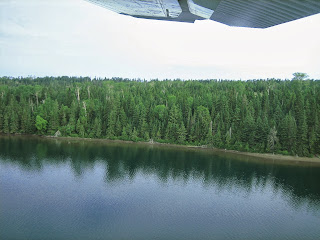

There is nothing on Isle Royale other than a very small National Park Service lodge (with a grill and tiny restaurant), a lookout tower, a former fish farm (and a place that Rolf Peterson, one of Isle Royale's premiere wolf researchers, calls home)

some cottages from the days before the island was made a national park,

a couple water taxis, the research station (on the southwestern tip of this forty-mile long island), and a whole lot of backcountry with some of the most spectacular scenery and fabulous flora and fauna you'll ever see.


Why do research here? In brief, the island's home to a number of isolated populations, and research has focused on moose and wolf populations, beginning back in the 1950s. Now, moose can swim between the mainland and the island, but wolves can't. So how did they get there in the first place? Ice bridges: Lake Superior typically freezes over at least a few days every year, although the thickness of this ice varies from a few centimeters to several inches (enough to support vehicles on an "ice highway" between Bayfield, WI and Madeline Island). Animals can cross ice bridges if they're thick enough, which is how the wolves got to the island in the first place. Unfortunately for them, the last ice bridge anywhere thick enough existed between Thunder Bay and the island happened in 1985. So the wolves are trapped, making them a pretty interesting population for study, and one that's been as high as 24 individuals in three different packs to where they are now: just eight wolves, in two packs, with a single female in a three wolf pack (The West End Trio), another three wolf pack (Chippewa Harbor) and two loners (one of which might be a female). There's been lots of debate on whether or not we ought to interfere to save the population. In a way, we already have; the wolves were decimated by parvovirus brought over by a tourist's (illegal) dog; and in 2012, a stunning seven wolves (including a female) died, three of them after falling into an abandoned copper mine shaft that has since been closed off. So things have looked pretty bleak for the wolves. As I recall, either no pups were born or survived as of two years ago--but researchers at Michigan Tech have recorded evidence of a few pups this past year. Study on these populations is year-round, but the most fruitful time for wolf study is during the winter, when there's no one on the island other than the researchers; Jon Vucetich, a wildlife ecology from Michigan Tech, leads the team and did a lovely series of blog entries on the research for the New York Times in 2012.
On the other hand, if you ever want to get into the act, you can volunteer to scrounge for moose bones during the Summer Research Season (but bring plenty of mosquito repellant).

Me, I just like to lace up the boots and hit the trails.


Because really, with vistas like this, no wonder Peter decided that, for him, this was heaven on Earth.


Houghton really is a college town, home to Michigan Tech University.

The Keweenaw Peninsula was also very big in terms of copper mining back in the day, and as I pointed out in my SHADOWS post last week, you can still visit the old Quincy Copper Mine and Hoist. After a day of touring around (or to give you that necessary jumpstart), you can't go wrong with a great cuppa at the Cyberia Café,

whose owner was nice enough to open up early for a caffeine-deprived writer AND let her hang out on his internet because hers wasn't working. And that brownstone synagogue Tom talks about near the end? Yup, Temple Jacob, with its very beautiful copper dome, is there, too--

to the right of the lift bridge.

Michigan Tech's real claim to fame is that the university's home to the Isle Royale Wolf and Moose Project, the longest running, continuous study of predator-prey populations in the world. Over forty miles long, Isle Royale is isolated and remote, the largest island in the largest inland lake in the world, and a place you really have to want to get to. Most people come by ferry (about 5 1/2 hours from Houghton, 1 1/2 from Thunder Bay, Ontario, or 3 hours and change from Grand Portage, MN),

or--if you can scrape together the change and spring for it--about 45 minutes from Houghton by seaplane (after a 5 1/2 hour drive to the town).


There is nothing on Isle Royale other than a very small National Park Service lodge (with a grill and tiny restaurant), a lookout tower, a former fish farm (and a place that Rolf Peterson, one of Isle Royale's premiere wolf researchers, calls home)

some cottages from the days before the island was made a national park,

a couple water taxis, the research station (on the southwestern tip of this forty-mile long island), and a whole lot of backcountry with some of the most spectacular scenery and fabulous flora and fauna you'll ever see.


Why do research here? In brief, the island's home to a number of isolated populations, and research has focused on moose and wolf populations, beginning back in the 1950s. Now, moose can swim between the mainland and the island, but wolves can't. So how did they get there in the first place? Ice bridges: Lake Superior typically freezes over at least a few days every year, although the thickness of this ice varies from a few centimeters to several inches (enough to support vehicles on an "ice highway" between Bayfield, WI and Madeline Island). Animals can cross ice bridges if they're thick enough, which is how the wolves got to the island in the first place. Unfortunately for them, the last ice bridge anywhere thick enough existed between Thunder Bay and the island happened in 1985. So the wolves are trapped, making them a pretty interesting population for study, and one that's been as high as 24 individuals in three different packs to where they are now: just eight wolves, in two packs, with a single female in a three wolf pack (The West End Trio), another three wolf pack (Chippewa Harbor) and two loners (one of which might be a female). There's been lots of debate on whether or not we ought to interfere to save the population. In a way, we already have; the wolves were decimated by parvovirus brought over by a tourist's (illegal) dog; and in 2012, a stunning seven wolves (including a female) died, three of them after falling into an abandoned copper mine shaft that has since been closed off. So things have looked pretty bleak for the wolves. As I recall, either no pups were born or survived as of two years ago--but researchers at Michigan Tech have recorded evidence of a few pups this past year. Study on these populations is year-round, but the most fruitful time for wolf study is during the winter, when there's no one on the island other than the researchers; Jon Vucetich, a wildlife ecology from Michigan Tech, leads the team and did a lovely series of blog entries on the research for the New York Times in 2012.
On the other hand, if you ever want to get into the act, you can volunteer to scrounge for moose bones during the Summer Research Season (but bring plenty of mosquito repellant).

Me, I just like to lace up the boots and hit the trails.


Because really, with vistas like this, no wonder Peter decided that, for him, this was heaven on Earth.


Monday, October 7, 2013
Trekking Through the ASHES Trilogy
I remember reading a scathing review of DRAW THE DARK a couple years ago where the person got all upset because I clearly hadn’t done my research or else I would know that Winter, WI (a real town, and a very nice one) is not even close to Milwaukee. I think the person also complained that you couldn’t see Lake Michigan from there either, but I haven’t gone back to check because life is too short to indulge in masochism.
What I recall, though, is being a little ticked off because clearly the person hadn’t bothered reading my acknowledgements where I flat-out say that the Winter I describe in the book is not based on the real Winter, WI. Really, I just loved the name and decided to go with it. But that was my first clue that people take these things seriously, and I do understand that you need a certain amount of verisimilitude, particularly if you’re going to talk about a place, and most especially if the setting is a key determinant of the narrative’s direction.
I think it was Ben Winters talking about Concord, NH, the setting for his Last Policeman series, who said he really wanted folks to have a mental map of that town so that if they ever went, they could stand on a street corner and say, Yep, there’s thus and such. People take Hobbiton tours and any number of Lord of the Rings tours; you can walk through the London neighborhoods where Holmes prowled, or—if your tastes are tad more modern—walk the beat around Lower Manhattan with Stabler and Benson from on Law & Order: SVU.
What we’re talking about here, of course, is setting. Setting puts characters in context and, IMHO, ought to be treated as a character in its own right. For me, if I can’t visualize or don’t know where my characters are, I really can’t construct them to be as real as possible. People react to setting as much as they react to situation and other people, and in fact, setting can create situations and act to bring people into narratives. Settings become so important that not only do people want to see where their favorite characters lived, but you--the writer--may even create a place your readers want to see for themselves.
I get a fair amount of fan mail about the ASHES trilogy, and many fans do ask about the places I mention in the books. (I’m always particularly thrilled when folks who live in Wisconsin or Michigan say that they recognize a lot of what I’m talking about, even when it’s fictional, as the town of Rule is.) But much of ASHES is based on real places, and so I thought that, over the next couple of weeks, I would take you on a bit of a guided tour through a few of the places mentioned in each book of the trilogy. This way, if you’re ever in the neighborhood, you can decide for yourself just how accurate my descriptions are. If they aren’t, please . . . don’t tell me. It ain't called literary license and fiction for nothing.
ASHES
Sheboygan, WI: Yes, there really is a Sheboygan. There are actually two; the other’s in Michigan. The Everly Brothers did, indeed, write a hit song entitled, “Mention My Name in Sheboygan,” and it’s quite the catchy tune.
Alex's Aunt Hannah hails from here (and, yup, there are scads of Lutherans; Lake Wobegone hasn't got them all), and it's a beautiful place, right on Lake Michigan.
![cfiles37300[1]](https://lh3.googleusercontent.com/blogger_img_proxy/AEn0k_uqL0EgfHIwAU-ZTeHvqk44POhKXVekyJY2TQffjuPMpY_3ahrs7KAQTnTjjPEsEwjJwfy9se9GylmvRxpkliZkzTle4o6s1Ylxo0BXYBX5yzAB6t6Wm4TYgkuB3QnOtTVlcX4Qo8Jm9AMfycd6qQ=s0-d) In the past, Sheboygan was a big manufacturing town for, of all things, chairs and ships. I’m not kidding. But it’s also heavily German, and so one of the other things it’s known for are its brats, something about which the New York Times wrote a nice article. The places they list to get great brats? Still here, and yes, Miesfield's makes brats to die for. Purists soak them in beer first, and I’m completely okay with that . . . except it does seem like a waste of a good beer.
In the past, Sheboygan was a big manufacturing town for, of all things, chairs and ships. I’m not kidding. But it’s also heavily German, and so one of the other things it’s known for are its brats, something about which the New York Times wrote a nice article. The places they list to get great brats? Still here, and yes, Miesfield's makes brats to die for. Purists soak them in beer first, and I’m completely okay with that . . . except it does seem like a waste of a good beer.
Rule, MI—Sorry, there is no Rule. There are, however, scores of small towns that were wholly given over to mining (iron and copper), lumber, or grist milling once upon a time and which dot the Upper Peninsula. There are six big iron-rich regions (ranges) in the area and one, the Gogebic, runs through the western part of the U.P. and into northern Wisconsin, and is where I envisioned Rule. Most MI mining these days is kaput, although there are a few active taconite mines. Wander through any of these smaller towns, and you get a sense for how they were once quite well-to-do but fallen on very tough times. Go through a tiny town with single traffic light or a four-stop at its center, and you’ve got Rule, in terms of what it once was, nailed. Or tour through one of the U.P.'s many mining ghost towns for a taste of how busy and developed this area once was. (Fayette's fun while Mandan, a copper mining town in the Keweenaw Peninsula and further east and north than where I envisioned Rule, is downright spooky.)
The region’s awash in mining history, too. In the first book, I mention an iron mining museum, and there is a fabulous one in Iron Mountain, MI, where you can, indeed, ride an ore cart about 2600 feet underground into this drift mine. (Yes, I’m jumping a little ahead of myself here since a mine doesn’t really become a “character” until SHADOWS, but let’s just go with it for a second.) In case you can’t make it all the way to visit Big John himself, you can always watch this video of the entire tour.
As I recall, I believe that Alex mentions a big Cornish pump. If she didn’t, shame on her, because this contraption, based in Iron Mountain, is an amazing piece of machinery. Mines filling up with water was/is a huge problem in the area, and the pump, designed for the Chapin Mine, is the largest steam-driven pump in the United States and one of the largest in the world. At the height of its operations, it removed about five million gallons of water (yes, that is million with an m) every day. You can see, then, where I’m going with this and how I got the idea for stuff that happens later in the trilogy. Anyway, if you’re in the neighborhood, you should stop by for a look-see. There’s also a very nice iron mining museum right alongside.
The Waucamaw Wilderness—nope, sorry, no Waucamaw either. But there is the Porcupine Mountains Wilderness State Park—the Porkies, to those of us who love them—that run right into and up to Lake Superior, and I used them as the models for the Waucamaw. Having hiked them a fair amount, I can tell you that what they may not have in height (these are pimples compared to the Shenandoahs, the White Mountains, you name it), these aren’t easy either. My favorite treks include Lake of the Clouds,
![266594929_dcc0cd41bc[1]](https://lh3.googleusercontent.com/blogger_img_proxy/AEn0k_tRRgQw8k5pgQG5IjB9adkyErkN-RbvOIBr82GtX1pVFD0Y5pftC-7gZga1EaHytvFljYVe3jHqOV6JL0zLMEgJ6rtj1HO5YAWy5Z_6ffho0YGVwjEqXR-Loyoq9ghiahA_K-Dpkru-9yxmiDomo6o9xl7UNMuEkpE=s0-d)
the view of Lake Superior from Summit Peak,
![porkies1[1]](https://lh3.googleusercontent.com/blogger_img_proxy/AEn0k_vItMAXBoF3dDTvSY2dfrjknUxtU7xlwPBMxWmTFKJ1kFYLcpHp-HZP_t6u3K2cX1QUykP5avIbNNqrRT1aXXdezOSo0v8OHHe9TRnqvuB82Ej-fB6yiu6JXTwp7Tq-gv-qONUG=s0-d)
anywhere along the Presque Isle River and its gorgeous waterfalls,
![porkies17[1]](https://lh3.googleusercontent.com/blogger_img_proxy/AEn0k_sXe3b-xZaJffeo6aqgNH1IMH-GmWB_j5t0d6LxgWeI8MGJwL2h40ENGe6OfmycJEitlaUpJliLjhSubW_0Ra8dCHuJ45lN_iO4pODD-BdEqmq2WIgpSDUFGGl1Bg5daAxT_Nqerg=s0-d)
![porkies23[1]](https://lh3.googleusercontent.com/blogger_img_proxy/AEn0k_tdMAnIIM7mo8Cmttpbj4FmUcKg9r2yR-qjkSTPqr9izilkVcTD46JTkUISU3x-XCVkbXxM6AvlnlHLHz-pb3quxcLxqEoGQq4VhK3Oxnu3rSeGhvX-dcpNHV5NvF4sx2GJWdL6rA=s0-d)
Government Peak and Mirror Lake,
![375025067_944ba07380[1]](https://lh3.googleusercontent.com/blogger_img_proxy/AEn0k_ua_N2enY5Yea_cq9tclc_pxTImLOeHu3Husmcyh5NgJTtLz35EUfWrRoZchuWUrc-GAomsEjrpEeqJhzGKYTIhXXfQif2BOttVH7djgMiwiyBQt_6hU8kOxDk0llZAaE9vVZ9xFhe_j_fPIgn8Zu9omnTL8VlIPvQ=s0-d)
And loads more. But nothing beats Lake Superior at sunset. This photograph by Steve Perry really does capture just how breathtaking and magical this place is, too.
![lake-superior-blazing-sunset[1]](https://lh3.googleusercontent.com/blogger_img_proxy/AEn0k_up5UYq4XoisJ9Ns9ZAg3EYX7UMYMCBJm0XDM7SUYCmhUxhalGrl7169hPiYUVfmE4qLxygUU2XhshFO42W-a9R6EYBnJVXXhP7G62pInwbbeTdE6FsdGhdSV5IgUlwBTRmq5SQ5AtOoqbMHIguP5tQvg8RV9WpMzxYnbS-rm36qw=s0-d)
Next week, we wander through SHADOWS.
And a final note: only five days left to enter for your chance at a signed copy of MONSTERS and an ASHES backpack. It's easy; just click the Goodreads link, on the right, top of the page!
What I recall, though, is being a little ticked off because clearly the person hadn’t bothered reading my acknowledgements where I flat-out say that the Winter I describe in the book is not based on the real Winter, WI. Really, I just loved the name and decided to go with it. But that was my first clue that people take these things seriously, and I do understand that you need a certain amount of verisimilitude, particularly if you’re going to talk about a place, and most especially if the setting is a key determinant of the narrative’s direction.
I think it was Ben Winters talking about Concord, NH, the setting for his Last Policeman series, who said he really wanted folks to have a mental map of that town so that if they ever went, they could stand on a street corner and say, Yep, there’s thus and such. People take Hobbiton tours and any number of Lord of the Rings tours; you can walk through the London neighborhoods where Holmes prowled, or—if your tastes are tad more modern—walk the beat around Lower Manhattan with Stabler and Benson from on Law & Order: SVU.
What we’re talking about here, of course, is setting. Setting puts characters in context and, IMHO, ought to be treated as a character in its own right. For me, if I can’t visualize or don’t know where my characters are, I really can’t construct them to be as real as possible. People react to setting as much as they react to situation and other people, and in fact, setting can create situations and act to bring people into narratives. Settings become so important that not only do people want to see where their favorite characters lived, but you--the writer--may even create a place your readers want to see for themselves.
I get a fair amount of fan mail about the ASHES trilogy, and many fans do ask about the places I mention in the books. (I’m always particularly thrilled when folks who live in Wisconsin or Michigan say that they recognize a lot of what I’m talking about, even when it’s fictional, as the town of Rule is.) But much of ASHES is based on real places, and so I thought that, over the next couple of weeks, I would take you on a bit of a guided tour through a few of the places mentioned in each book of the trilogy. This way, if you’re ever in the neighborhood, you can decide for yourself just how accurate my descriptions are. If they aren’t, please . . . don’t tell me. It ain't called literary license and fiction for nothing.
ASHES
Sheboygan, WI: Yes, there really is a Sheboygan. There are actually two; the other’s in Michigan. The Everly Brothers did, indeed, write a hit song entitled, “Mention My Name in Sheboygan,” and it’s quite the catchy tune.
Alex's Aunt Hannah hails from here (and, yup, there are scads of Lutherans; Lake Wobegone hasn't got them all), and it's a beautiful place, right on Lake Michigan.
![cfiles37300[1]](http://www.ilsajbick.com/wp-content/uploads/2013/10/cfiles373001.jpg)
Rule, MI—Sorry, there is no Rule. There are, however, scores of small towns that were wholly given over to mining (iron and copper), lumber, or grist milling once upon a time and which dot the Upper Peninsula. There are six big iron-rich regions (ranges) in the area and one, the Gogebic, runs through the western part of the U.P. and into northern Wisconsin, and is where I envisioned Rule. Most MI mining these days is kaput, although there are a few active taconite mines. Wander through any of these smaller towns, and you get a sense for how they were once quite well-to-do but fallen on very tough times. Go through a tiny town with single traffic light or a four-stop at its center, and you’ve got Rule, in terms of what it once was, nailed. Or tour through one of the U.P.'s many mining ghost towns for a taste of how busy and developed this area once was. (Fayette's fun while Mandan, a copper mining town in the Keweenaw Peninsula and further east and north than where I envisioned Rule, is downright spooky.)
The region’s awash in mining history, too. In the first book, I mention an iron mining museum, and there is a fabulous one in Iron Mountain, MI, where you can, indeed, ride an ore cart about 2600 feet underground into this drift mine. (Yes, I’m jumping a little ahead of myself here since a mine doesn’t really become a “character” until SHADOWS, but let’s just go with it for a second.) In case you can’t make it all the way to visit Big John himself, you can always watch this video of the entire tour.
As I recall, I believe that Alex mentions a big Cornish pump. If she didn’t, shame on her, because this contraption, based in Iron Mountain, is an amazing piece of machinery. Mines filling up with water was/is a huge problem in the area, and the pump, designed for the Chapin Mine, is the largest steam-driven pump in the United States and one of the largest in the world. At the height of its operations, it removed about five million gallons of water (yes, that is million with an m) every day. You can see, then, where I’m going with this and how I got the idea for stuff that happens later in the trilogy. Anyway, if you’re in the neighborhood, you should stop by for a look-see. There’s also a very nice iron mining museum right alongside.
The Waucamaw Wilderness—nope, sorry, no Waucamaw either. But there is the Porcupine Mountains Wilderness State Park—the Porkies, to those of us who love them—that run right into and up to Lake Superior, and I used them as the models for the Waucamaw. Having hiked them a fair amount, I can tell you that what they may not have in height (these are pimples compared to the Shenandoahs, the White Mountains, you name it), these aren’t easy either. My favorite treks include Lake of the Clouds,
![266594929_dcc0cd41bc[1]](http://www.ilsajbick.com/wp-content/uploads/2013/10/266594929_dcc0cd41bc1.jpg)
the view of Lake Superior from Summit Peak,
![porkies1[1]](http://www.ilsajbick.com/wp-content/uploads/2013/10/porkies11.jpg)
anywhere along the Presque Isle River and its gorgeous waterfalls,
![porkies17[1]](http://www.ilsajbick.com/wp-content/uploads/2013/10/porkies171.jpg)
![porkies23[1]](http://www.ilsajbick.com/wp-content/uploads/2013/10/porkies231.jpg)
Government Peak and Mirror Lake,
![375025067_944ba07380[1]](http://www.ilsajbick.com/wp-content/uploads/2013/10/375025067_944ba073801.jpg)
And loads more. But nothing beats Lake Superior at sunset. This photograph by Steve Perry really does capture just how breathtaking and magical this place is, too.
![lake-superior-blazing-sunset[1]](http://www.ilsajbick.com/wp-content/uploads/2013/10/lake-superior-blazing-sunset1.jpg)
Next week, we wander through SHADOWS.
And a final note: only five days left to enter for your chance at a signed copy of MONSTERS and an ASHES backpack. It's easy; just click the Goodreads link, on the right, top of the page!
Monday, July 22, 2013
Trilogy-itis?
Earlier this week, a blog on what I would call "trilogy-itis" appeared on YALSA's The Hub. I think the author of the piece has some very valid points although for me, most would apply to movies. (Red 2. Fast and Furious 4. IronMan 3. Die . . . Whatever. Seriously?) And even stringing folks along with endless sequels isn't new; just think back to the old Saturday matinee serials, like Captain Marvel and The Perils of Pauline (which are, really, more legitimately considered continuations rather than sequels but go with it). Heck, if you want to blame someone for creating a recurring series character, go talk to Arthur Conan Doyle. Yes, pretty much each story was a standalone, but over time, reader familiarity bred an expectation of more of the same. Doyle didn't bother to keep track of every detail, but his readers sure did and still do. That poor guy couldn't get clear of Sherlock Holmes--and even so, Doyle's embrace of a recurring character owes itself to a) Poe, a writer Doyle quite admired and who wrote two stories featuring the same detective and b) the well-established practice of novel serializations/installments, something Dickens and many other writers did because that was the industry back then. In a way, they had to; it's how they made their living because they were paid by the word or installment. Dickens and Collins and their ilk were the pulp fiction writers of their day.
So, really, multiple parts to stories that stretch over long periods of time is nothing new (or even confined solely to literature). Serialization, continuations, and recurring characters are part and parcel of the mystery and thriller genres.
Anyway, I'd encourage you to read the piece (it's relatively brief). For those of you not so inclined, the gist of it all is that, in the author's opinion, there are just way too many trilogies out there these days--and, more importantly, not all of them seem justified. That is, the story being developed doesn't seem to support or call for that much material and, by extension, an investment of time (and money) by her, the reader.
Okay, I can sort of see that in certain cases and, like I said, the author raises some good points. (Tell the truth, did you really expect a sequel to the original Star Wars? The answer is no; the production company manufactured the need.) But I can also categorically say that three of her contentions are dead wrong. Of course, we're only talking about my experience; I can't vouch for other authors. But here's where I take issue.
Anyway, I'd encourage you to read the piece (it's relatively brief). For those of you not so inclined, the gist of it all is that, in the author's opinion, there are just way too many trilogies out there these days--and, more importantly, not all of them seem justified. That is, the story being developed doesn't seem to support or call for that much material and, by extension, an investment of time (and money) by her, the reader.
Okay, I can sort of see that in certain cases and, like I said, the author raises some good points. (Tell the truth, did you really expect a sequel to the original Star Wars? The answer is no; the production company manufactured the need.) But I can also categorically say that three of her contentions are dead wrong. Of course, we're only talking about my experience; I can't vouch for other authors. But here's where I take issue.
One is with this notion that keeping track of long, over-arching plots after a year's absence is so hard. Come on, really? Are you telling me that you really didn't remember what happened between Star Wars and The Empire Strikes Back? Return of the Jedi? The whole Lord of the Rings trilogy? Yes, I picked movies, but they're not necessarily "easier." Really, if you've connected with a character's story, I'm not sure why it should be that tough to get back there in a sequel (and without a dreaded recap). To a certain extent, thriller and mystery writers routinely expect that readers will recall pertinent details about recurring characters and previous plot lines (and again, without the need for a recap) even if what they're presenting is a (sort of) standalone. I say "sort of" because many mystery series feature characters with families or friends, who all change over time--and you, the reader, have to keep up (or invest some energy and read the earlier books--or just gloss over what you don't know and go on with the story). My own prejudice, I guess, is that if a writer does her job, there's no need for an info dump to clue you in on what's gone on before. (Certainly Dickens didn't think it was necessary.) When people become invested in a character, they tend to remember the important bits.
So maybe what we're really talking about here is that this is a new request? demand? investment? on the part of the writer for the YA reader. I agree with the author here. For heaven's sake, if you don't feel like expending the emotional energy or brain space to keeping track of this and that, don't do it. But just because some writers do info dumps doesn't mean all do (I didn't), and that's because I trust that my readers have a brain. The trick is putting in pertinent details to jog memories (for example, I don't give a blow by blow about a character having been shot in a previous book; that would be boring: "Well, you know, Bob, I really thought you were a goner when the bad guys popped out from behind those bushes. Do you remember when that happened?" "Why, yes, Stan, I do. Near around April, wasn't it? Yeah, and by golly, gosh, I took one in the leg. Want to see my scar?" But if I show a character having some trouble with a bum leg or massaging a scar or whatever . . . I trust that this is enough to help the reader recall: aha; right, he got shot. See? No info dump. That was a show, not a tell.
A second point the author makes is that she figures a
writer can't sell sf or fantasy these days "if you're not willing to divide it into pieces." Nope; not true. I know because I have and plan to keep doing so. [In fact, my fans complain because they want sequels to books like Draw the Dark (a paranormal mystery) and Drowning Instinct (a contemporary, but I'm just saying).]
Further, her statement presupposes that an author has somehow got some huge book that's only waiting to be divided--and, uhm, that would be no. I can't imagine any writer plopping a twelve hundred page manuscript on an editor's desk. (Well, okay, Stephen King did that with The Stand--he really did; I was in the audience when the editor told that story--but I'm talking us mere mortals.) More often than not, I'll bet that trilogies come about as a result of an author having finished only the first book of a projected story (notice I say story not trilogy) that she hasn't really developed all the way or even begun to write. Anything else is just a vague idea: a six-page synopsis or, maybe, only a few paragraphs. It was that way with JK Rowling (in fact, I don't believe she really envisioned some huge series; she wrote a modest little middle-grade fantasy that did only okay and then she tried a couple other stories and then things took off).
With ASHES, I had a finished book and an idea of where the story ought to go and that's it. I said as much in an article that came out late this week on PW. [That piece featured nine authors (including me) whose series are coming to an end and what that feels like and is all about. You can read the first part of the article here; for those of without a subscription, you unfortunately can't read what we authors had to say, although I did post my portion on my Facebook page.]
With ASHES, I had a big story, with multiple plotlines and characters, to tell. But I only written the first installment and originally planned on one other book. It was a (very gifted) editor who understood, even before I did, that I had much more going on in the ASHES universe than I knew at the time.
But I hasten to add that this is not the same as the author's other point with which I take issue: that editors somehow wring three books out of authors whether they're ready or not. No way; listen, an editor would be putting his job on the line if he pulled crap like that. Publishing houses spend money to acquire these things; people don't realize the amount of work that goes into the production of even a single book. No editor's going to pay a writer for a story that might turn out only half-assed or crappy. That's ridiculous.
For me, if the ASHES story hadn't supported or needed three books, I wouldn't have agreed to write them (and, again, my ASHES editor had nothing to do with crafting or demanding or writing the story). In a way, that trilogy grew as I came to know and understand my characters--something that can only happen when you've got the luxury of time to let things spin out. I was so incredibly fortunate to have that time, too; I can't tell you. These characters truly took on lives of their own. Now, I know I could tell more stories in that universe. I've got the rudiments of a fourth book in my head; I know where I'd go next. But for that series as a whole, I've done pretty much what I set out to do--and, as I said, even that changed over time.
For me, I think the bottom line is that I write as much as the story requires. Sometimes that's a standalone; sometimes that's a trilogy and at other times, as with my forthcoming WHITE SPACE, that's two books. Could I write more books in either the ASHES or DARK PASSAGES series? Sure. For example, I am only now beginning the WS sequel, and it's possible that the ideas churning around in my head could expand and beg for a third book. Not planning on it--I know the end I'm working toward here--but you never know.
Because characters and their stories really surprise you. They do, and sometimes you have to give them the time and have the patience to allow their stories to grow.
Monday, April 29, 2013
Not All About You
This past week, I had the great good fortune to be part of the TLA. Meeting librarians (some of my favorite people), other authors whom I admire, and fans aside, I also got to sit on a sf/fantasy panel with some fabulous writers, all of whom give me the green envies: like . . . why didn't I think of that? (And, crap, they dress well.) In hindsight, there were also several questions where, after I'd heard a response, I thought, <DOH!> I wish I'd said . . . x, y, z.
One question, though--really, two questions bundled into one--got me to thinking. Specifically, how much does a dystopian or apocalyptic scenario reflect the writer's personal vision, and why is it that adolescents seem to groove on these books so much? I'm perfectly happy with the answers I gave--which, yeah, I'll partially recap here but have written quite a bit about in other venues--but I was struck by how different my personal vision is/was from my fellow panelists.
Look, here's the skinny on the personal vision stuff: the reality is that if a book didn't reflect a fairly substantial chunk of what a writer believes, the book wouldn't work. Period. You just can't fake this stuff. You have to truly believe what you're writing; the book must reflect your personal vision, regardless of genre or circumstance. Readers can spot a faker a mile off. So if you don't invest your narrative with every drop of conviction, you might as well hang it up.
What I found pretty interesting was that of my fellow panelists, I seemed to be the only pessimist in the bunch. (Maybe the others were lying; beats me.) Now this might be what comes of being a Freudian or from personal history . . . probably there's some truth to that . . . but it was striking and, honestly, a little troubling, mainly because I think that if anyone has paid any attention to history, you realize that people are really a) quite savage, b) selfish, and c) not all that nice when the chips are down. I mean, God, turn on the news; go read about how many elephants were slaughtered last year just for their tusks, if you don't believe me, or which species is teetering on the brink of extinction this week.
Now, it's also true that people like reading stories (and seeing movies) where things work out, or there's some semblance of hope. No one likes an eternal downer as entertainment (which, you have to remember, is what we writers are doing: providing entertainment). It's the reason I like going to the occasional chick-flick; I couldn't live on the stuff, but I do love that little break and a good cry. It is just as true that teens love dystopias and apocalyptic books because they provide a vicarious avenue for grappling with seemingly insurmountable odds--and winning. Surviving. And not only winning or surviving: doing the right and noble thing.
I recognize this; I truly believe that there are a few good and noble people. But I guess I'm still quite pessimistic, and most especially about the idea that, no matter how bad things might get here on Earth, we humans will adapt, somehow.
Now, the reason I find that a little disconcerting is that while it might be correct--and I think the jury's still out on that; there are plenty of civilizations that have come and gone before us, and species, too--it reflects a vision of the Earth as something that matters only to humans. It is an anthrocentric point of view. Sure, okay: maybe we'll adapt and discover new tech and wander around breathing with special filters and living under domes, but I don't think anyone would much enjoy the world as, say, imagined by Phillip K. Dick, or one where the only forests exist on space ships (as in 1972's Silent Running). It is, in fact, a view that ignores the reality that while we might adapt--and that's a big might because if we don't curb population growth and stop outstripping the carrying capacity of the planet, we will drain our aquifers, period, and there are huge regions of the planet without enough water right this very second--this isn't only about us, about people. It's about all the organisms with which we share this planet: living beings that will not adapt because the changes are too rapid and the alternatives, too few. They will die, as they are dying now; as we destroy and decimate their habitats, species will continue to vanish at an alarming rate, as they are vanishing now. That is reality.
Let me give you a disheartening example of just this kind of antrocentric thinking: if you've been following me on Twitter or Facebook, then you know that I've been watching a mother fox and her litter of five kits for the past couple of weeks. The mom just happened to make her den under a neighbor's deck, and watching this little family was so special I can't tell you. It was a true gift and opportunity not many people have, and I know that several neighbors felt the same way. Yeah, fine, so my cats couldn't go out; BFD. A couple neighbors even thought that, cool, the rabbits won't eat their lettuce.
Unfortunately, the guy whose deck it was . . . he was pissed. And, no, before you ask: no chickens, no pets, no kids. In fact, the guy and his wife are rarely home. The foxes weren't in his house. They were under the bloody deck. The mom chased my cats twice (the first indication I had that she was around), but that was it, and she really only barked at them. (Winslow, that stinker, was much more interested in being friends, I think.) When I wandered outside, that mom just sat down and we had a good long look at each other, and we did that several times. She watched me every morning at the bird feeder; our coversation was a bit one-sided, but she was polite about it. She brought some of the kits over to our yard to hang out. It was lovely.
Anyway, the neighbor guy wanted to get rid of the fox and her kits. I have to say that I was floored; we live in a rural area; the woods are literally across the street and all around; there are coyotes and raccoons and opossums and foxes and deer and . . . you get the picture. So this guy called the DNR (they wisely said forget it); called a pest control guy (ditto). Then he decided, fine, he'd scare the hell out of the animals: blasted rock music all day and put on big bright spots at night.
And, yes, before you ask: I went over to talk to him. Nicely. Just to feel him out. His primary thing was it was his land, his property, and he wanted those animals gone.
So . . . sad to say, he succeeded. The foxes cleared out. I spotted mom a couple times after I got back from Texas, but only one kit, curled up next to the shed maybe thirty feet from my back door. Sweetest little guy. He was there last night but gone this morning, and my guess is mom-fox told him to stay put until she got back, and then they went off together. (I've found out from a wildlife rehab person that this kind of thing--planting the kids and telling them to wait here--frequently happens.)
But when you have a reality like that--this sense of entitlement that man has about what is his versus what he shares--it's hard not to get, well, a little discouraged. To be a little über-sensitive when you hear that we humans will "adapt." Yes, perhaps: but at what price?
Someone once asked if I didn't think my fiction was too "graphic," the violence too "real" for kids. Uhm . . . well . . . no, I don't. Nothing I include is gratuitous. Everything I write, and this pertains to the violence, too, is no more graphic than a video game, a graphic novel, or the latest episode of The Walking Dead. When I include a traumatic or horrible detail, it is to reinforce that, yes, actions have consequences. Pull a trigger, someone may die, and it may be, in fact, a horrible thing to see. It may, in fact, be more horrible to do.
But I do not believe that a writer has a duty to teach moral lessons or find "truth," because truth depends on who you are and what you believe, and we all have parents. Sorry: I'm a writer; I'm an entertainer; it's not in my job description. Yet, at times, I do struggle with balancing out the reality that I see and know with the hope that, maybe, something will change. Perhaps this is why I focus so much in my fiction on both the bad choices people make and their repercussions: because I do want kids (and adults) to stop a moment and consider before they act. I especially want kids to understand that nearly every action has a consequence; every decision an effect; that we truly are connected to one another and this Earth, for better or worse, and you are not necessarily more important than anyone or anything else. In the end, I want them to see: really, this isn't all about you.
One question, though--really, two questions bundled into one--got me to thinking. Specifically, how much does a dystopian or apocalyptic scenario reflect the writer's personal vision, and why is it that adolescents seem to groove on these books so much? I'm perfectly happy with the answers I gave--which, yeah, I'll partially recap here but have written quite a bit about in other venues--but I was struck by how different my personal vision is/was from my fellow panelists.
Look, here's the skinny on the personal vision stuff: the reality is that if a book didn't reflect a fairly substantial chunk of what a writer believes, the book wouldn't work. Period. You just can't fake this stuff. You have to truly believe what you're writing; the book must reflect your personal vision, regardless of genre or circumstance. Readers can spot a faker a mile off. So if you don't invest your narrative with every drop of conviction, you might as well hang it up.
What I found pretty interesting was that of my fellow panelists, I seemed to be the only pessimist in the bunch. (Maybe the others were lying; beats me.) Now this might be what comes of being a Freudian or from personal history . . . probably there's some truth to that . . . but it was striking and, honestly, a little troubling, mainly because I think that if anyone has paid any attention to history, you realize that people are really a) quite savage, b) selfish, and c) not all that nice when the chips are down. I mean, God, turn on the news; go read about how many elephants were slaughtered last year just for their tusks, if you don't believe me, or which species is teetering on the brink of extinction this week.
Now, it's also true that people like reading stories (and seeing movies) where things work out, or there's some semblance of hope. No one likes an eternal downer as entertainment (which, you have to remember, is what we writers are doing: providing entertainment). It's the reason I like going to the occasional chick-flick; I couldn't live on the stuff, but I do love that little break and a good cry. It is just as true that teens love dystopias and apocalyptic books because they provide a vicarious avenue for grappling with seemingly insurmountable odds--and winning. Surviving. And not only winning or surviving: doing the right and noble thing.
I recognize this; I truly believe that there are a few good and noble people. But I guess I'm still quite pessimistic, and most especially about the idea that, no matter how bad things might get here on Earth, we humans will adapt, somehow.
Now, the reason I find that a little disconcerting is that while it might be correct--and I think the jury's still out on that; there are plenty of civilizations that have come and gone before us, and species, too--it reflects a vision of the Earth as something that matters only to humans. It is an anthrocentric point of view. Sure, okay: maybe we'll adapt and discover new tech and wander around breathing with special filters and living under domes, but I don't think anyone would much enjoy the world as, say, imagined by Phillip K. Dick, or one where the only forests exist on space ships (as in 1972's Silent Running). It is, in fact, a view that ignores the reality that while we might adapt--and that's a big might because if we don't curb population growth and stop outstripping the carrying capacity of the planet, we will drain our aquifers, period, and there are huge regions of the planet without enough water right this very second--this isn't only about us, about people. It's about all the organisms with which we share this planet: living beings that will not adapt because the changes are too rapid and the alternatives, too few. They will die, as they are dying now; as we destroy and decimate their habitats, species will continue to vanish at an alarming rate, as they are vanishing now. That is reality.
Let me give you a disheartening example of just this kind of antrocentric thinking: if you've been following me on Twitter or Facebook, then you know that I've been watching a mother fox and her litter of five kits for the past couple of weeks. The mom just happened to make her den under a neighbor's deck, and watching this little family was so special I can't tell you. It was a true gift and opportunity not many people have, and I know that several neighbors felt the same way. Yeah, fine, so my cats couldn't go out; BFD. A couple neighbors even thought that, cool, the rabbits won't eat their lettuce.
Unfortunately, the guy whose deck it was . . . he was pissed. And, no, before you ask: no chickens, no pets, no kids. In fact, the guy and his wife are rarely home. The foxes weren't in his house. They were under the bloody deck. The mom chased my cats twice (the first indication I had that she was around), but that was it, and she really only barked at them. (Winslow, that stinker, was much more interested in being friends, I think.) When I wandered outside, that mom just sat down and we had a good long look at each other, and we did that several times. She watched me every morning at the bird feeder; our coversation was a bit one-sided, but she was polite about it. She brought some of the kits over to our yard to hang out. It was lovely.
Anyway, the neighbor guy wanted to get rid of the fox and her kits. I have to say that I was floored; we live in a rural area; the woods are literally across the street and all around; there are coyotes and raccoons and opossums and foxes and deer and . . . you get the picture. So this guy called the DNR (they wisely said forget it); called a pest control guy (ditto). Then he decided, fine, he'd scare the hell out of the animals: blasted rock music all day and put on big bright spots at night.
And, yes, before you ask: I went over to talk to him. Nicely. Just to feel him out. His primary thing was it was his land, his property, and he wanted those animals gone.
So . . . sad to say, he succeeded. The foxes cleared out. I spotted mom a couple times after I got back from Texas, but only one kit, curled up next to the shed maybe thirty feet from my back door. Sweetest little guy. He was there last night but gone this morning, and my guess is mom-fox told him to stay put until she got back, and then they went off together. (I've found out from a wildlife rehab person that this kind of thing--planting the kids and telling them to wait here--frequently happens.)
But when you have a reality like that--this sense of entitlement that man has about what is his versus what he shares--it's hard not to get, well, a little discouraged. To be a little über-sensitive when you hear that we humans will "adapt." Yes, perhaps: but at what price?
Someone once asked if I didn't think my fiction was too "graphic," the violence too "real" for kids. Uhm . . . well . . . no, I don't. Nothing I include is gratuitous. Everything I write, and this pertains to the violence, too, is no more graphic than a video game, a graphic novel, or the latest episode of The Walking Dead. When I include a traumatic or horrible detail, it is to reinforce that, yes, actions have consequences. Pull a trigger, someone may die, and it may be, in fact, a horrible thing to see. It may, in fact, be more horrible to do.
But I do not believe that a writer has a duty to teach moral lessons or find "truth," because truth depends on who you are and what you believe, and we all have parents. Sorry: I'm a writer; I'm an entertainer; it's not in my job description. Yet, at times, I do struggle with balancing out the reality that I see and know with the hope that, maybe, something will change. Perhaps this is why I focus so much in my fiction on both the bad choices people make and their repercussions: because I do want kids (and adults) to stop a moment and consider before they act. I especially want kids to understand that nearly every action has a consequence; every decision an effect; that we truly are connected to one another and this Earth, for better or worse, and you are not necessarily more important than anyone or anything else. In the end, I want them to see: really, this isn't all about you.
Monday, August 6, 2012
The Last Word
A few nights ago, I participated via Internet in a big teen lock-in and got a question I hear frequently: why did I choose to end ASHES the way I did? Now, for those of you who haven't read the book, never fear. I won't ruin it by telling you HOW it ends. Let's just say that I broke several rules, and I did that on purpose. In fact, the end breaks enough rules that a recent Horn Book article talked specifically about this: that the "shocking" conclusion was among the "coolest" examples of an author being "daring enough (or heartless enough, depending on your tolerance for sad endings) to let their protagonists face seemingly insurmountable obstacles and find that they are, indeed, just that."
Which is pretty darned cool in and of itself.
But, back to the question. Why did I do that? Well, whenever I'm asked, I always ask the question right back, not because I'm being coy but I want to hear what or how people think/feel/react. The answer I hear most frequently is that I did it to make people buy the sequel. EEEEHHHH! Wrong. (Although it's true that my editor and I went back and forth about this--he was a tad nervous about breaking SO many rules--when I explained why, he was right on board.) Some people think I'm trying to be shocking just for the sake of being shocking, and that's also wrong, but it's a tad closer to what I was thinking and trying to convey. Going for that emotional gut-punch isn't far off.
Let's think, though, about what good beginnings and endings do for us. A great beginning grabs our attention, right? But a fabulous beginning sentence or paragraph also sets the tone for the novel; it hints at what's in store. For example, one of my favorite beginning lines of all time belongs to William Gibson's cyberpunk classic, Neuromancer: "The sky above the port was the color of television, tuned to a dead channel." Oh, my goodness, is that evocative or what? You instantly "see" that sky; you know what color it is; you also know that we're talking a lot of light and tech because only a ton of light--and that means, a big city--has the ability to wash out a black sky and bright stars. (Or skies are muddy orange; I've noticed this in places like New York, where I wonder if people even remember that looking up is fun to do.) Regardless, that line sets up the entire book. You've garnered tons of information from fifteen words. Fifteen. That's amazing.
Similarly, a great last line (or last couple of lines) sends the reader and the book on her way, and if the writer is very skilled, evokes the mood the writer wants you to walk away with. For example, at the end of Laurie Halse Anderson's Speak, poor mute Melinda, who's found not only courage and closure but her voice, has the last word: "Let me tell you about it."
Hand's down, though, I think that Libba Bray is fabulous at these type of send-off last lines/last paragraphs, and IMHO, her best work can be found in her Gemma Doyle series. All her last lines are great, but my particular favorites (lines and paragraphs) can be found at the end of A Strange and Terrible Beauty:
"The wind shifts, bringing with it the smell of roses, strong and sweet. Across the ravine, I see her in the dry crackle of leaves. A deer. She spies me and bolts through the trees. I run after her, not really giving chase. I'm running because I can, because I must.
Because I want to see how far I can go before I have to stop."
This is a perfect send-off for that first book because it is all about beginnings and a young woman daring to break the rules. This end does, in fact, set up the beginning of the next book and helps you understand where this series is headed.
Most often, when I reach the end of a book I'm writing, I know what the last line is because I knew it from the beginning, and the whole book has been a journey to that last line. The one time I was a little surprised by where I ended up was at the end of SHADOWS, not because the line hadn't been "said" in my head already but because it wasn't the last line/scene but the penultimate scene. When I got to the end, though, and penned what I had imagined the last line ought to be, it just didn't feel right. Just didn't. I realized after a few minutes that the book's journey had really ended the scene before. So I switched them around, and now I do think that SHADOWS ends in a way that both evokes what I want to people to feel and summarizes the journey. (I'm sure you'll tell me if I'm right.)
But back to ASHES: this is the G-d's honest truth about why I ended it the way I did. It's actually kind of artsy-fartsy, but my reasoning went like this: ASHES is a book about what happens when the world falls apart. Nothing remains that you recognize; all the niceties are swept away. Alex has to endure in that world, where all the old rules no longer apply. So my feeling was if she has to do that, why should you get a break? I wanted you to experience the same kind of shock and dislocation she does, that moment when you finally, truly understand that nothing will ever be the same again.
That's why I did it. Do I succeed? I dunno; you tell me. But I sure hear enough from people who are FRANTIC to find out what happens next; who are so shocked and upset they want to yell and scream at me (that's fine; just be civil); who think about throwing their books or Kindles across the room (some actually do). All that's good because that means you felt something. You weren't indifferent. You weren't . . . oh, cool. You were . . . SAY WHAT?
All good. Mission accomplished. That you care is all and the best a writer can hope for.
Which is pretty darned cool in and of itself.
But, back to the question. Why did I do that? Well, whenever I'm asked, I always ask the question right back, not because I'm being coy but I want to hear what or how people think/feel/react. The answer I hear most frequently is that I did it to make people buy the sequel. EEEEHHHH! Wrong. (Although it's true that my editor and I went back and forth about this--he was a tad nervous about breaking SO many rules--when I explained why, he was right on board.) Some people think I'm trying to be shocking just for the sake of being shocking, and that's also wrong, but it's a tad closer to what I was thinking and trying to convey. Going for that emotional gut-punch isn't far off.
Let's think, though, about what good beginnings and endings do for us. A great beginning grabs our attention, right? But a fabulous beginning sentence or paragraph also sets the tone for the novel; it hints at what's in store. For example, one of my favorite beginning lines of all time belongs to William Gibson's cyberpunk classic, Neuromancer: "The sky above the port was the color of television, tuned to a dead channel." Oh, my goodness, is that evocative or what? You instantly "see" that sky; you know what color it is; you also know that we're talking a lot of light and tech because only a ton of light--and that means, a big city--has the ability to wash out a black sky and bright stars. (Or skies are muddy orange; I've noticed this in places like New York, where I wonder if people even remember that looking up is fun to do.) Regardless, that line sets up the entire book. You've garnered tons of information from fifteen words. Fifteen. That's amazing.
Similarly, a great last line (or last couple of lines) sends the reader and the book on her way, and if the writer is very skilled, evokes the mood the writer wants you to walk away with. For example, at the end of Laurie Halse Anderson's Speak, poor mute Melinda, who's found not only courage and closure but her voice, has the last word: "Let me tell you about it."
Hand's down, though, I think that Libba Bray is fabulous at these type of send-off last lines/last paragraphs, and IMHO, her best work can be found in her Gemma Doyle series. All her last lines are great, but my particular favorites (lines and paragraphs) can be found at the end of A Strange and Terrible Beauty:
"The wind shifts, bringing with it the smell of roses, strong and sweet. Across the ravine, I see her in the dry crackle of leaves. A deer. She spies me and bolts through the trees. I run after her, not really giving chase. I'm running because I can, because I must.
Because I want to see how far I can go before I have to stop."
This is a perfect send-off for that first book because it is all about beginnings and a young woman daring to break the rules. This end does, in fact, set up the beginning of the next book and helps you understand where this series is headed.
Most often, when I reach the end of a book I'm writing, I know what the last line is because I knew it from the beginning, and the whole book has been a journey to that last line. The one time I was a little surprised by where I ended up was at the end of SHADOWS, not because the line hadn't been "said" in my head already but because it wasn't the last line/scene but the penultimate scene. When I got to the end, though, and penned what I had imagined the last line ought to be, it just didn't feel right. Just didn't. I realized after a few minutes that the book's journey had really ended the scene before. So I switched them around, and now I do think that SHADOWS ends in a way that both evokes what I want to people to feel and summarizes the journey. (I'm sure you'll tell me if I'm right.)
But back to ASHES: this is the G-d's honest truth about why I ended it the way I did. It's actually kind of artsy-fartsy, but my reasoning went like this: ASHES is a book about what happens when the world falls apart. Nothing remains that you recognize; all the niceties are swept away. Alex has to endure in that world, where all the old rules no longer apply. So my feeling was if she has to do that, why should you get a break? I wanted you to experience the same kind of shock and dislocation she does, that moment when you finally, truly understand that nothing will ever be the same again.
That's why I did it. Do I succeed? I dunno; you tell me. But I sure hear enough from people who are FRANTIC to find out what happens next; who are so shocked and upset they want to yell and scream at me (that's fine; just be civil); who think about throwing their books or Kindles across the room (some actually do). All that's good because that means you felt something. You weren't indifferent. You weren't . . . oh, cool. You were . . . SAY WHAT?
All good. Mission accomplished. That you care is all and the best a writer can hope for.
Subscribe to:
Posts (Atom)